'Decentralization' Is Not Another Buzzword
Power, the internet, and the case for self-hosting
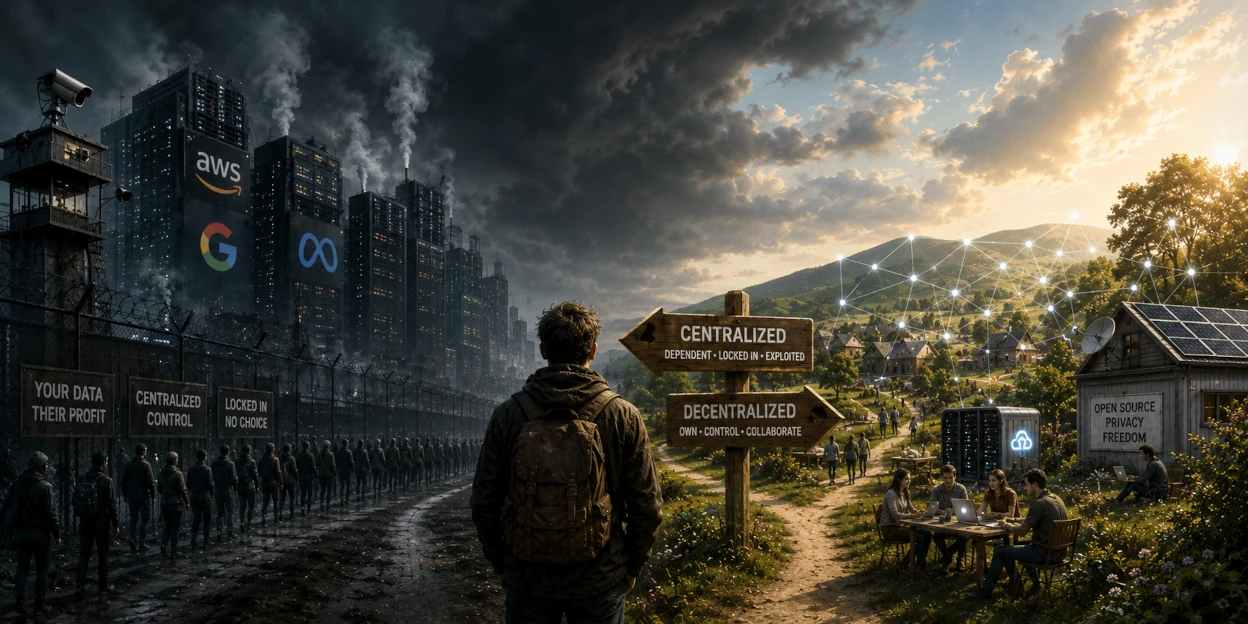
A little overview of history before we move on to today’s internet and cloud computing infrastructure.
Human beings have looked at power structures throughout history and whatever ‘ism’ was ultimately applied by leaders, one thing should be obvious to anyone — what was really being studied, above all else, was where the centre of power could be found, and how it could be exploited or manipulated.
Whether that centre point was too far away, too large or in the wrong place, is something for abstractionists of political power to decide, whatever period they are studying.
I’ve come to the conclusion that overly rigid control systems stifle creativity, and not just the artistic type of creativity — the general type of creativity that lets everyday people thrive, keep the energy of their labour, and move and communicate freely.
Of course there are rules, or ways of forcing order — but too many or over-enforcement of them quickly leads to disenchantment, or worse.
And that can lead to dangerous environments and circumstances.
A mixed revolution
The internet has certainly been described as a ‘revolution’, and it’s been a mixed one.
It is indeed easy to be upbeat about a high-speed more-interconnected world, online shopping, Wikipedia, E2E chat and FOSS platforms for collaboration, regardless of your position on the USA’s power and its projection.
But whether or not these outweigh the negative effects of dark patterns and the addiction-causing algorithms of the latest revolution, is up to you.
I’m tempted to fall on the side of no, it doesn’t. But it might.
And this is not because I subscribe to a theory that technology has some sort of supernatural ability to reduce human society’s ethical discernment, but rather the centralization of power that’s taken place over the last 30 years — thanks largely to the centralization of the internet — the colossal data centres, cloud giant dependency and software giants locking you out, not just of your rights but of your data.
So I’m ditching the Ted Kaczynski sympathizers, instead turning to a quote from British statesman John Dalberg-Acton:
“Power tends to corrupt, and absolute power corrupts absolutely.”
The famous quote goes on:
“Great men are almost always bad men, even when they exercise influence and not authority, still more when they establish the supreme authority.”
— Lord Acton —
Lord Acton was likely talking about the concentration of unchecked power inevitably leading to corruption, and when we apply this to the modern internet, we can start to imagine how we can decentralize it and start taking it back to what it was, without giving up any of the recent technical advancements.
And I’m not going to provide an unneeded judgement of the big tech leaders. Wherever you see them on a scale from questionable businessmen to dark overlords leading us into a Minority Report-esque dystopian non-future, let’s look at how we can go about grassroots attempts at improving the internet.
What self-hosting actually means
Self-hosting (whether remotely or with local hardware) is already part of the decentralization of the modern, digitally interconnected world. It’s more than just sharing family photos from a Raspberry Pi in your living room using Immich, although this is admirable and a necessary step.
For scope, we need to further define self-hosting. It’s often presented as the example above — a hobbyist running a mini-PC or Raspberry Pi at home. A whizz on the command line. Hardware expenditures, although often under a few hundred dollars, and the learning curve, dissuade some.
But a VPS can be rented for less than some domestic subscription service, and running a mini-PC or Raspberry Pi is surprisingly easy on the electricity bill. And those command line tricks can be learned, with a little community support. A volunteer IT professional can be enlisted.
The main point of self-hosting is that you control (with free software) what happens on your server and that you can actually manage and audit it. And, of course, you are not running any big tech platforms.
The scalability happens when other people (often non-tech users) see the genius in what you are doing and join you, either by using the services your self-hosted instance provides themselves, or by starting their own.
How far can this go?
Of course it’s hard to tell exactly how much of a dent this will make in the big tech empires, and full decentralization (however that could be defined) may ultimately never happen.
Personally, I am convinced that we can make progress in the next ten years. Awareness of self-hosting and free software is growing as people look for alternatives to the giants — not just for political and social reasons, but because we want a better digital quality of life.
And Google isn’t the air and water people have been led to believe it is.
James Earll is Cloudillo’s Social and Outreach Coordinator. In his spare time, he enjoys fountain pens, reading and spending time with his family, interrupted by the occasional outrageous adventure!